For supervising dentists and office managers
Your EFDA places the temporary reline. You stay the dentist.
One $249 online course trains your Oregon EFDA to apply temporary soft relines to complete dentures. You authorize each case, stay in the building and check the result. Diagnosis, the material choice and every clinical decision stay with you.
Enrollment opens soon. Join the waitlist and we’ll email you the day it opens.
OAR 818-042-0090(2)
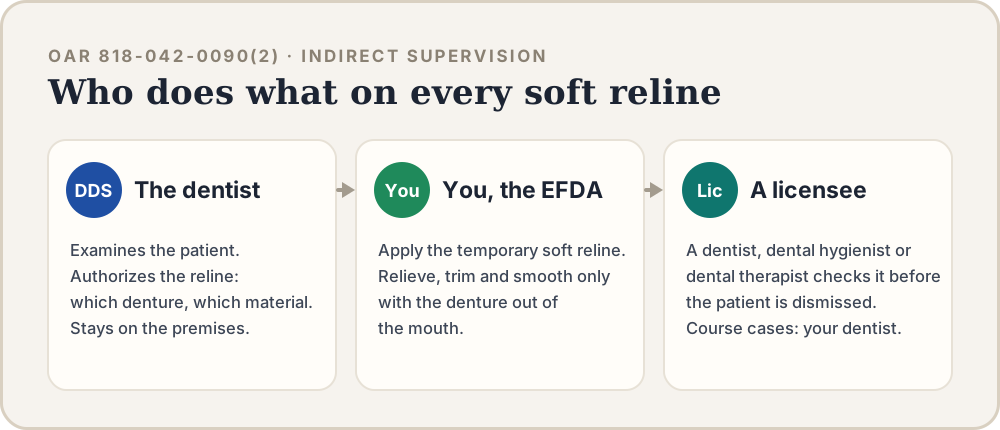
Who does what on every reline
Under OAR 818-042-0090(2), a trained Oregon EFDA may apply temporary soft relines to complete dentures for tissue conditioning. This course gives you that training, from an Oregon Board of Dentistry–approved soft reline instructor.
“Apply temporary soft relines to complete dentures for the purpose of tissue conditioning.”
Your part
Five things, and two of them happen once
The course does the teaching and the instructor approves your EFDA’s technique on a practice denture first. Your part is the supervision Oregon’s rule already requires, plus two signatures.
- 1
Sign a two-page agreement
Before your EFDA’s first patient, read and sign the Supervising Dentist Agreement. Your EFDA uploads it in the first module.
Once, before the first patient
- 2
Authorize each case
Examine the patient and tell your EFDA which complete denture, which material, and any relief or trimming you want. Your EFDA is taught to ask if any of those is missing.
Each case, at your exam
- 3
Stay on the premises
Oregon calls this indirect supervision: you authorize the procedure and are in the building while it is done. You do not need to be in the operatory.
Each case
- 4
Check the reline before the patient leaves
Look at the liner, the borders, the bite, the patient’s comfort and the tissue, then initial that line of the case log.
Each case, before dismissal
- 5
Complete a short checklist after patient 2
The Dentist Competency Checklist records what you saw, with your Oregon license number. Mark “Not met” if that is what you saw.
Once, at the end
What stays your decision
- Whether a patient gets a temporary soft reline at all
- Which denture and which material, and how soft
- Where to relieve, and how to handle fresh extraction sites
- Anything on the tissue: your EFDA describes it and never names a diagnosis
- When the patient returns and what definitive treatment follows
When your EFDA stops and gets you
- Anything on the tissue that looks like a lesion
- A cracked or broken denture, or one with attachments
- A history flag that hasn’t been addressed, such as a reaction to acrylic
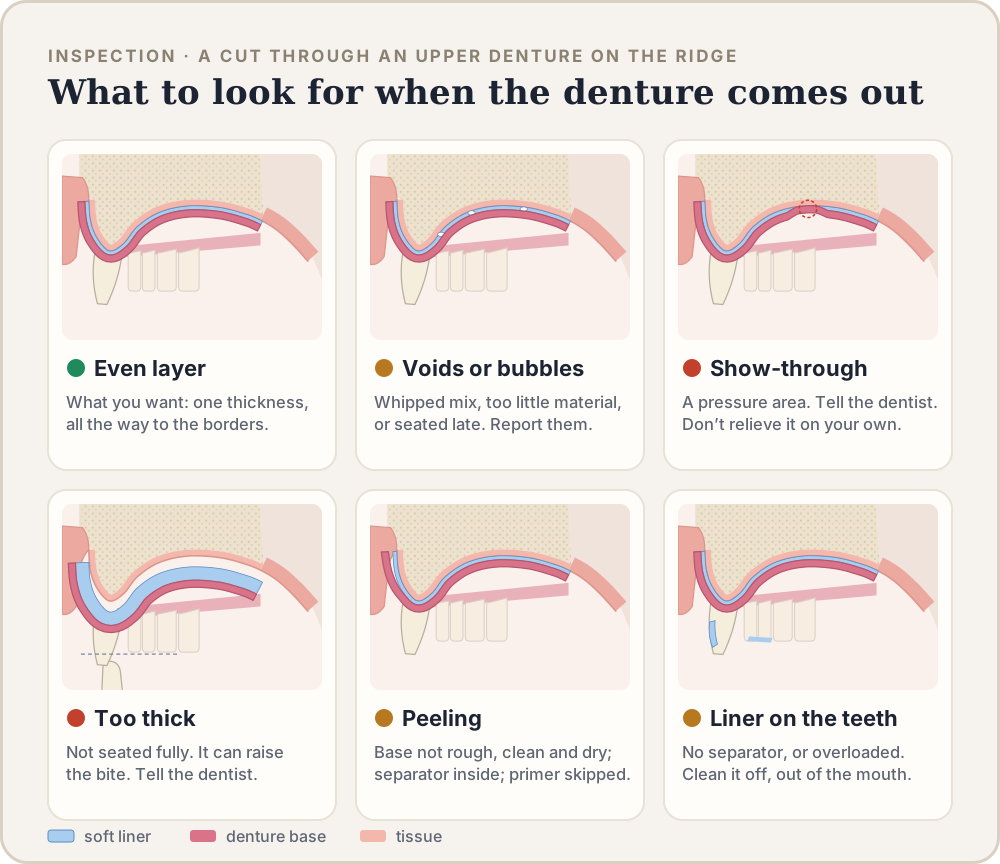
- Show-through or a bite that feels high after the reline
- A patient who can’t tolerate the procedure
- Burning, itching, swelling or any other allergy sign
Inside the limits
Trained to the rule, not past it
- Complete dentures only, upper or lower, including immediate dentures. No partials.
- Temporary soft relines only. No hard relines, long-term soft liners or rebases.
- Nothing adjusted in the mouth. Relief, trimming and smoothing happen with the denture out.
- A licensee checks every reline before the patient is dismissed.
The course teaches temporary soft relines on complete dentures only. Oregon rules don’t allow dental assistants to do hard relines, long-term soft liners or partial dentures (OAR 818-042-0040(19)), so the course doesn’t teach them.
Paperwork
Short forms, ready to print
Chart numbers only. No patient names, birth dates, photos or radiographs go to the course. Consent forms and chart notes stay at your office.
Supervising Dentist Agreement
You sign it once, before the first patient.
Supervising Dentist Quick Guide
One page on what the course covers and what supervising involves.
Clinical Case Log
One line per patient, by chart number. You initial each line.
Dentist Competency Checklist
You complete it after the second patient.
Patient Home-Care Handout
Your EFDA gives one to every reline patient.
Patient Consent Template
Optional, if your usual consent doesn’t cover it.
Incident Report
Only if something goes wrong.
Questions
What dentists ask first
More answers are on the course FAQ.
Am I responsible for teaching the technique?
No. The course teaches the rule, patient assessment, infection control, anatomy, materials, the step-by-step technique, complications and charting, and the instructor approves a recorded lab check-off on a practice denture before your EFDA touches a patient’s denture. You supervise the 2 patient cases and sign off what you saw.
Do I have to be in the room?
No. The rule calls for indirect supervision: you authorize the procedure and are on the premises while it is done. If you leave the building, your EFDA waits.
Can my hygienist do the check?
Oregon’s rule lets a licensee, meaning a dentist, dental hygienist or dental therapist, check the reline before the patient is dismissed. On the 2 course cases, the course asks the supervising dentist to do the check and initial the case log.
Which material will my EFDA use?
Yours. The course names no brands. It teaches your EFDA to read the directions for the product in your office and to use the powder-to-liquid ratio, mixing time, working time and time in the mouth printed there.
What can’t my EFDA do, even after the course?
Hard relines, long-term soft liners, rebases, any reline on a partial denture, and any adjustment while the denture is in the mouth. Oregon’s prohibited acts for dental assistants cover all of these (OAR 818-042-0040).
What if our office rarely sees denture patients?
Your EFDA has 6 months of access to finish, including the 2 patient cases. If your office rarely sees patients who need a temporary reline, your EFDA can ask the instructor for an extension before access ends.
Is anything filed with the Board?
No. There’s nothing to file with the Board, no state fee and no renewal. Your EFDA’s Certificate of Completion is issued by the Board-approved instructor and kept on file at your office.
Can the office pay?
Yes. An office can pay with its card at checkout.
Online certificate course for Oregon EFDAs
Ready to hand off temporary relines?
100% online, self-paced coursework. The hands-on parts happen at your own office. No class day, no travel, no time off work. An office can pay with its card at checkout.
- $249 one-time, 6 months of access
- About 4 hours of coursework, at your pace
- 2 supervised patients at your own office
- A Certificate of Completion for your office’s files