Placement of Pit and Fissure Sealants
Your dentist’s part in the course
You take the course. Your dentist supervises the hands-on part at your own office. Here is exactly what that means, on one page you can show your dentist before you enroll.
- Cost
- $299
- one-time; an office card works at checkout
- Coursework
- About 7 hours
- online, at your own pace
- Time off work
- None
- the lab and the patient happen at your office
- Filed with the Board
- Nothing
- and no state fee
What the rule allows
Four conditions, every patient
Under OAR 818-042-0090, an Oregon EFDA who completes a course of instruction approved by the Board may apply pit and fissure sealants under indirect supervision.
You don’t diagnose, plan treatment or cut tissue, and you never choose the teeth. Which teeth to seal, and with what, is the dentist’s call.
Read OAR 818-042-0090Examined and authorized first
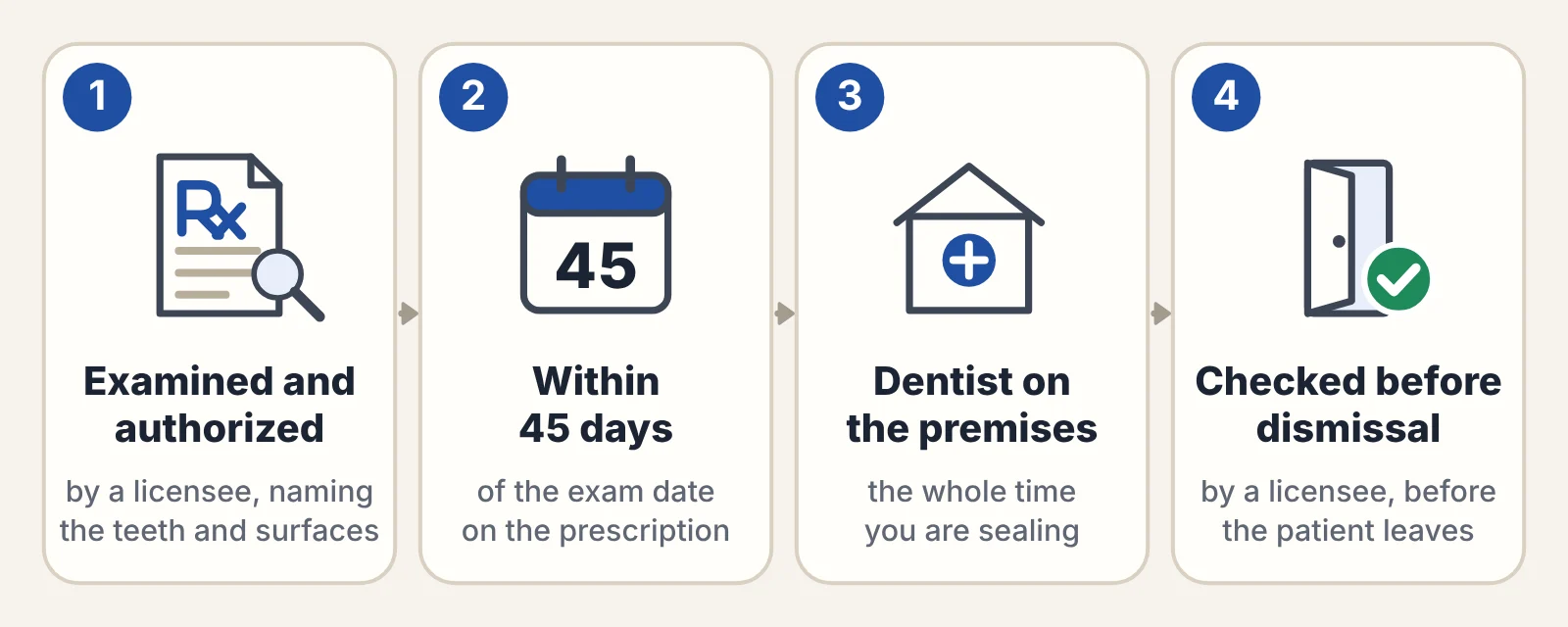
A licensee (a dentist, dental hygienist or dental therapist) examines the patient and authorizes the sealants, naming the tooth surfaces.
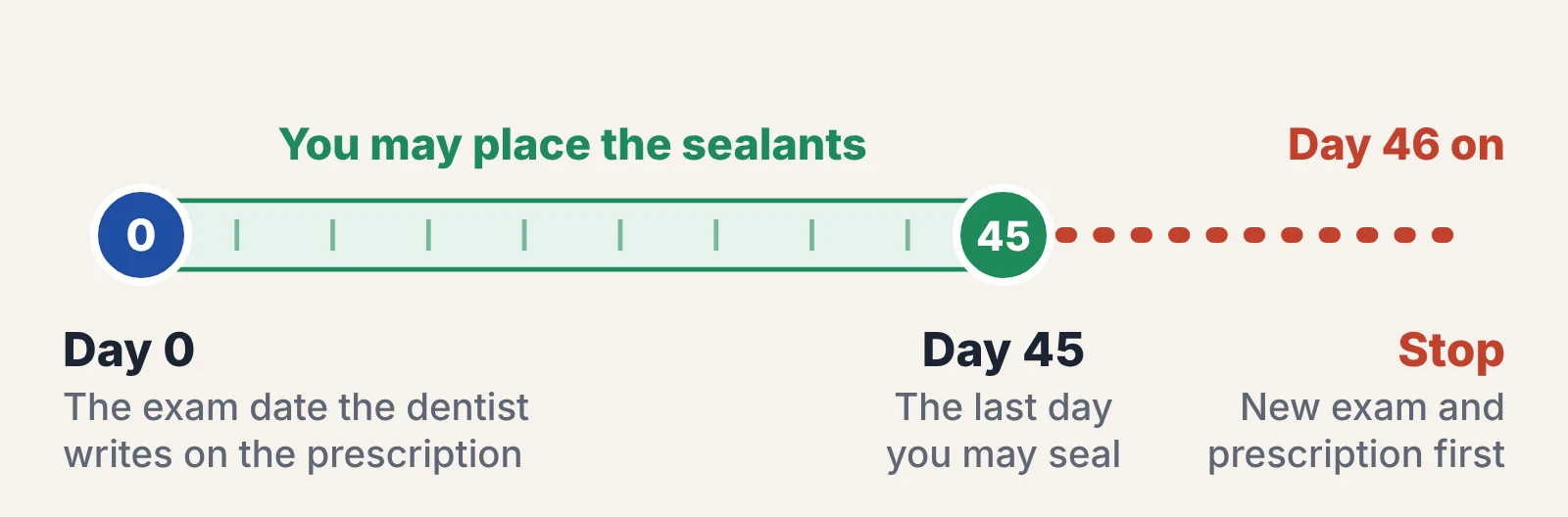
Within 45 days
The exam date is day 0. Day 45 is the last day you can place the sealants.
A dentist on the premises
That is indirect supervision: a dentist authorizes the procedure and is in the building while you place the sealants.
Checked before dismissal
A licensee checks your sealants before the patient leaves.
What your dentist does
Six things, from the agreement to the last signature
You do the coursework. Your dentist supervises the hands-on part at your own office.
Signs the Supervising Dentist Agreement
A short agreement you upload in Module 0, before anything else.
Lets you record the lab at the office
Two extracted, amalgam-free, sterilized teeth, with the office’s materials and curing light. No patients or patient information on camera.
Examines your patient and signs the prescription
After Dr. Smith approves your lab video, your dentist examines the patient and signs the Board’s prescription form that day, with the exam date and the tooth surfaces: at least two fully erupted molars or premolars.
Stays on the premises
While you place the sealants.
Checks your sealants
Before the patient is dismissed, and signs the certification at the bottom of the Board’s form. The original goes in the chart.
Signs your packet
Your Clinical Case Log and a one-page Dentist Competency Checklist, each item marked Met or Not met.
For your course patient, the course is stricter
The rule lets any licensee examine, prescribe and check. For your course patient, your supervising dentist does all three. A hygienist or dental therapist can’t stand in on the course patient. As a course rule, the dentist adjusts a high sealant; you tell the dentist instead of adjusting it.
Patient privacy
Chart numbers only. No patient names, birth dates, photos or radiographs go to the course. You upload a copy of the Board’s form with the patient’s name blacked out, and the original stays in the chart.
What your office supplies
The office’s teeth, materials and patient
- Two extracted molars or premolars with no fillings or decay, or a two-tooth kit arranged through the school
- The office’s own sealant material, etchant and curing light
- An operatory for about an hour for your lab video
- One patient who needs sealants on at least two fully erupted molars or premolars
Does your dentist have a question first? Call (971) 361-4710 or email admissions.
Questions about your dentist’s part
How do I ask my dentist?
Show them this page. The course also gives you a one-page Supervising Dentist Quick Guide to hand over, and the agreement they sign is short.
Can our hygienist supervise my course patient?
Not for the course patient. The course asks your supervising dentist to examine the patient, sign the prescription, be on the premises and check the sealants. After your certificate, the rule’s own conditions apply: any licensee may examine, authorize and check, with a dentist on the premises.
Who decides which teeth get sealed?
The dentist. You place the sealants a licensee has authorized and never choose the teeth.
Does anything get filed with the Board?
No. You get a Certificate of Completion to keep on file at your office. There’s nothing to file with the Board and no state fee.
What happens after the certificate?
The four conditions apply to every sealant you place: examined and authorized first, placed within 45 days, a dentist on the premises, and checked by a licensee before the patient is dismissed.
What if something goes wrong during my patient’s visit?
Stop and get the dentist; the patient comes first. Then make sure Dr. Smith hears about it and an Incident Report is filled out. The course supplies the form.
Can my office pay?
Yes. An office can pay with its card at checkout.
Online certificate course for Oregon EFDAs
Ready to add sealants to your chairside skills?
100% online, self-paced coursework. The lab and your patient happen at your own office. No class day, no travel, no time off work. An office can pay with its card at checkout.
- $299 one-time, 6 months of access
- About 7 hours of coursework, at your pace
- 1 supervised patient at your own office
- A Certificate of Completion for your office’s files